

Circle Formula Explained: Your Ultimate Guide to Understanding Circles

When you think about circles, you might picture a simple shape from your school days. But circles are everywhere - from the wheels on your car to the design of a clock. Understanding how to work with circles is essential, especially if you want to master geometry or apply it in real-world scenarios like construction or design. Today, I’m going to walk you through everything you need to know about circles, focusing on the core concept: the circle formula.
Whether you’re a business owner in San Antonio’s dental, legal, construction, or home trades sectors, grasping this concept can help you visualize projects better, communicate ideas clearly, and even optimize your marketing visuals. Let’s dive in!
Circle Formula Explained: The Basics You Need to Know
First things first - what exactly is a circle? A circle is a set of points in a plane that are all the same distance from a fixed point called the center. That fixed distance is called the radius. Simple, right? But here’s where it gets interesting.
The circle formula is a mathematical way to describe all those points that make up the circle. It’s a powerful tool that helps you calculate the size, position, and other properties of a circle. This formula is essential in many fields, including architecture, engineering, and even digital marketing design.
Here’s the standard form of the circle formula:
\[
(x - h)^2 + (y - k)^2 = r^2
\]
\( (h, k) \) is the center of the circle.
\( r \) is the radius.
\( (x, y) \) represents any point on the circle.
This formula tells you that the distance from any point on the circle to the center is always the radius. It’s like a rule that every point on the circle must follow.
Understanding this formula lets you do things like:
Calculate the area and circumference of a circle.
Determine if a point lies inside, outside, or on the circle.
Plot circles accurately on graphs or blueprints.
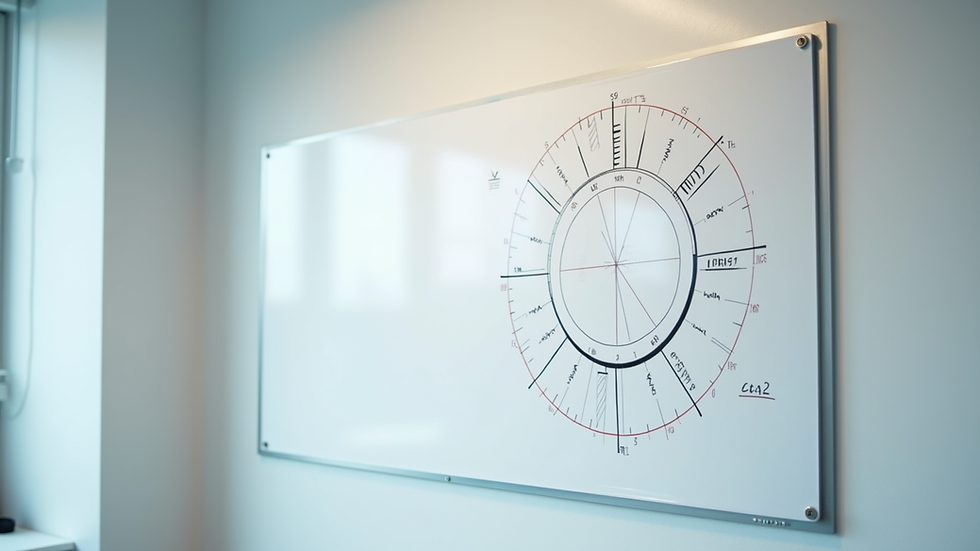
What is the equation of the circle?
Now that you know the basics, let’s break down the equation of the circle in more detail. The equation I mentioned earlier is the standard form of a circle’s equation. But there’s also the general form, which looks like this:
\[
x^2 + y^2 + Dx + Ey + F = 0
\]
Here, \(D\), \(E\), and \(F\) are constants that relate to the circle’s center and radius. You can convert this general form back to the standard form by completing the square, which is a handy algebraic technique.
Why does this matter? Because sometimes, when you’re working with data or measurements, the circle’s equation might not be neatly presented in standard form. Knowing how to switch between forms helps you analyze and use the circle’s properties effectively.
For example, if you’re designing a circular window or a round table, you might start with measurements that fit the general form. Converting to the standard form helps you find the exact center and radius, ensuring your design is precise.
How to Calculate the Area and Circumference of a Circle
Once you understand the circle formula, calculating the area and circumference becomes straightforward. These two measurements are crucial in many practical applications, like estimating materials needed for a circular patio or the length of fencing around a round garden.
Area tells you how much space the circle covers.
Circumference tells you the distance around the circle.
Here are the formulas:
Area: \( A = \pi r^2 \)
Circumference: \( C = 2 \pi r \)
Let’s say you have a circle with a radius of 5 feet. Plugging that into the formulas:
Area = \( \pi \times 5^2 = 25\pi \approx 78.54 \) square feet
Circumference = \( 2 \times \pi \times 5 = 10\pi \approx 31.42 \) feet
Knowing these numbers helps you plan better. For instance, if you’re a contractor estimating how much paint to buy for a circular ceiling, the area tells you the surface size, while the circumference helps if you’re installing molding around the edge.

Practical Applications of the Circle Formula in Your Business
You might be wondering, “How does this math stuff apply to my business?” Great question! Whether you’re in dental, legal, construction, or home trades, understanding circles and their formulas can give you an edge.
For Construction and Home Trades
Designing round features: Think about circular windows, arches, or garden layouts. Using the circle formula helps you calculate dimensions accurately.
Material estimation: Calculate the area for flooring or the circumference for trim and molding.
Blueprint accuracy: When drawing plans, the circle formula ensures your curves are precise, avoiding costly mistakes.
For Dental and Legal Practices
Visual marketing: Circles are often used in logos, infographics, and website design. Knowing the circle formula helps you create balanced, eye-catching visuals.
Spatial planning: If you’re redesigning your office or waiting room, circular layouts can improve flow and comfort. Use the formula to plan seating arrangements or circular signage.
Digital Marketing Edge
Here’s a little insider tip: when you work with a digital marketing partner like the circle formula, you’re tapping into expertise that understands these geometric principles. They can help you create visuals and campaigns that resonate locally in San Antonio, turning clicks into clients.
Tips for Mastering the Circle Formula Quickly
If you want to get comfortable with the circle formula fast, here are some actionable tips:
Visualize the circle: Draw it out. Seeing the center, radius, and points helps you understand the formula better.
Practice with real numbers: Use examples like a circle with radius 3 or 7 and calculate area and circumference.
Convert between forms: Try rewriting the general form to the standard form and vice versa.
Use graphing tools: Online graphing calculators can plot circles based on your equations, making it easier to grasp.
Apply it to your work: Think about how circles appear in your projects or marketing materials and use the formula to solve related problems.
Unlocking Growth with the Right Formula
Understanding the circle formula is more than just a math exercise. It’s a way to bring precision, clarity, and creativity into your business. Whether you’re planning a construction project, designing a logo, or optimizing your office layout, this knowledge empowers you to make smarter decisions.
If you want to see measurable online growth and consistently turn clicks into new clients, partnering with experts who understand these fundamentals is key. They’ll help you apply concepts like the circle formula in ways that boost your local presence in San Antonio’s competitive market.
So, next time you see a circle, remember - it’s not just a shape. It’s a powerful tool waiting to be unlocked.
Ready to take your business to the next level? Start by mastering the basics, and watch how the right formula can transform your approach.


Comments